Brand Audits: The Best “Bad News” Money Can Buy
The house looks perfect on the walkthrough: light in the kitchen, fresh paint on the porch rail, and by the second bedroom you are already deciding where the couch goes. Then an inspector you paid four hundred dollars crawls out from under it with photographs of the foundation, and the afternoon goes quiet.
Nobody orders a home inspection to hear that the house is lovely. You order one because this is the most money you will ever spend on something you cannot see the inside of, and because falling for a place is exactly what keeps you out of the crawl space. The report comes back mostly bad news. That is the report doing its job.
A brand audit is the same purchase, for the same reason, with the same quiet afternoon at the end of it.
Tropicana skipped the crawl space. It put a new carton on shelves on January 8th, 2009, and announced it was going back to the old one on February 23rd. Sales of Pure Premium fell 20% in those six weeks, roughly $30 million of orange juice, and Ad Age was reporting the number while the new cartons were still in the case. Every internal review that carton was supposed to clear, it cleared, because a mockup in a conference room is the walkthrough and the cold case in a grocery store is the crawl space. The thing that sank the redesign, a shopper scanning the shelf who could no longer find her juice, is exactly what the walkthrough never shows.
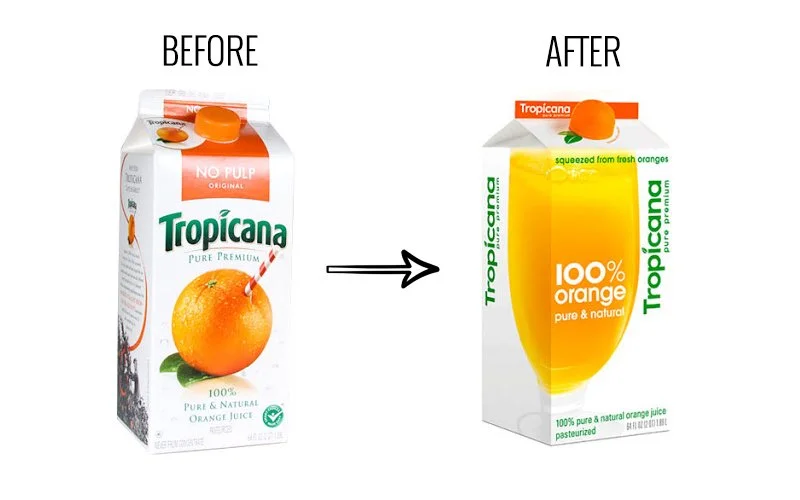
The 2009 redesign, before and after. Image via The Branding Journal.
An audit is the attempt to catch that before the pallet ships.
What It Actually Finds

Mostly it finds that you are already inconsistent, and that you had no idea by how much.
Adobe’s research on brand operations puts it plainly. 81% of companies say they are dealing with content that does not follow their own brand guidelines, only about a quarter of the ones that have guidelines say they enforce them, and 15% have no guidelines at all. Those are not scrappy startups with no process. Those are companies that wrote the rules themselves and then watched a decade of decks, one-pagers, trade show booths and Instagram posts wander off in every direction.
The second thing it finds is the distance between the sentence you use to describe your company and the sentence a customer uses. Marty Neumeier compressed the entire discipline into one line in The Brand Gap:
“It’s not what you say it is. It is what they say it is.”
A good audit is largely the work of writing both sentences down next to each other and measuring the gap.
The third finding is the expensive one, and it is the reason a founder goes quiet in the middle of the meeting. It is the distance between what your product is worth and what your presentation of it is worth, and it arrives as a price you have been too shy to charge.
The fourth is the one nobody expects, which is that something is already working and you were about to kill it. Tropicana had that. The old carton was not fashionable. It was findable, which turns out to be most of the job. Every inspection report has one line like that, the ugly thing the inspector tells you not to touch. I have sat in the meeting where someone says the old thing tested fine and then nobody in the room can produce the test.
The Numbers Your Agency Will Quote You

This is the point where a person in this business hands you a statistic, so take mine with the receipt attached.
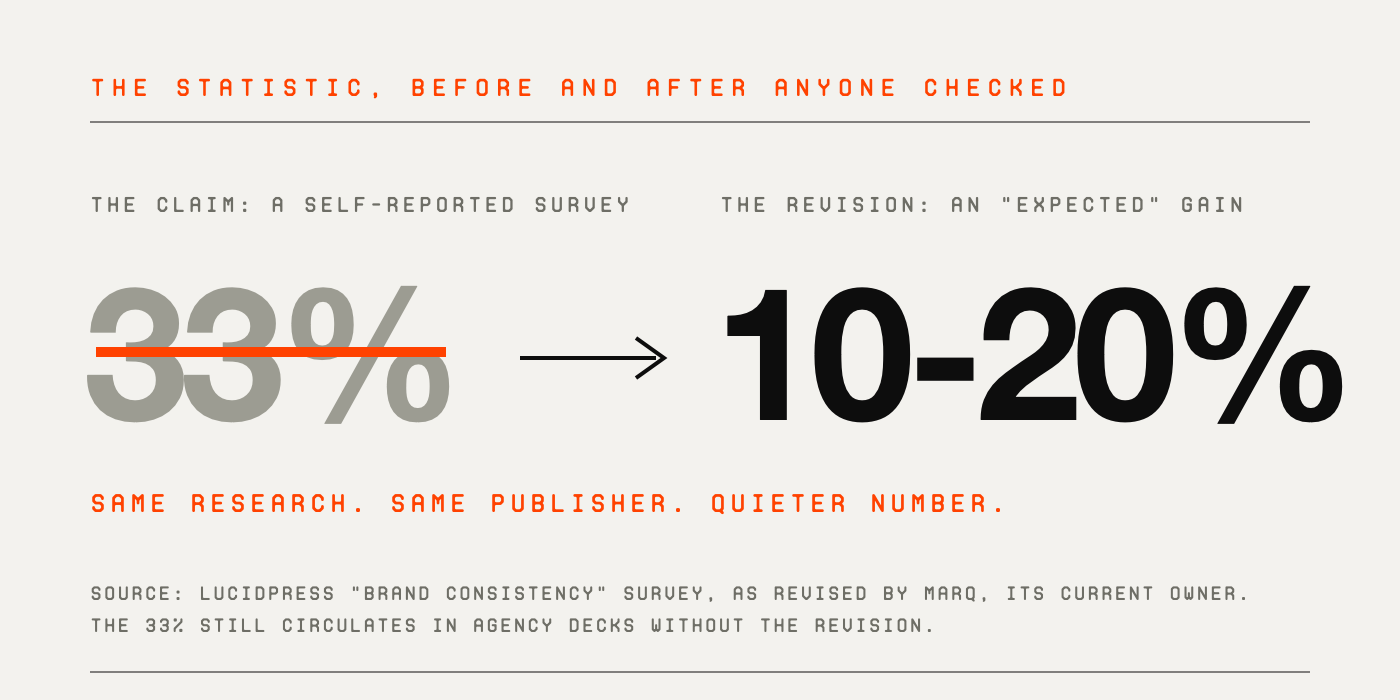
You have probably seen the claim that consistent branding increases revenue by 33%. It comes from a Lucidpress survey of roughly two hundred organizations, and the word survey is doing heavy lifting there. That is people reporting what they believe about their own branding, not audited revenue. Marq, which owns that research now, has quietly moved to a softer figure of 10 to 20% and frames it as what respondents expect consistency to be worth. That is a real downgrade, and almost nobody quoting the 33% mentions it.
The better evidence is duller and much harder to argue with. McKinsey built a design index across 300 publicly listed companies over five years, tracking more than two million pieces of financial data. Top-quartile scorers grew revenue 32% faster than their industry peers and returned 56% more to shareholders. That study does not say a logo makes money. It says companies that treat design decisions with the same rigor they give pricing decisions tend to be the ones that win, which is a different claim and a far less flattering one.
When You Do Not Need One

Plenty of the time you do not.
If you have been selling for under a year you do not need an audit, you need more customers to argue with. If you already know exactly what is wrong and you want someone to confirm it, that is a proposal you are shopping for, not an audit. And if what you want is permission to run the redesign you have already decided on, save your money. Nobody orders an inspection for a house they have already decided to gut to the studs, and an honest audit is the most expensive way to be told no that you will ever buy.
Jaguar is the useful example here, though not in the way it usually gets used. European sales fell to 49 cars in April 2025 against 1,961 the year before, and that 97% number gets waved around as proof a rebrand destroyed a company. Carscoops pointed out the obvious thing, which is that Jaguar had deliberately stopped building cars during that window. The rebrand may still turn out to be a mistake. That particular statistic is not how anyone would prove it. Somebody putting that chart in a pitch deck is hoping you do not check, and that is not analysis, it is a fucking sales prop.
What You Are Actually Buying

The deliverable is not a document. It is a shorter list of things you are allowed to argue about.
Before an audit, every meeting about the brand can go anywhere, because every opinion in the room is equally unfalsifiable and the loudest person wins. After one, some of those opinions have evidence attached and the rest do not, and the meeting gets forty minutes shorter. That is the whole return. It is not inspiring and it does not make a good case study.
What it does mean is that the next expensive decision gets made by people who have looked at the shelf instead of the mockup. If you want to see the questions that work gets built on, they are here.
Tropicana’s team had the same budget in February that they had in January. The only thing that changed was what they knew, and it cost them thirty million dollars to learn it in public.
TL;DR
A brand audit is a home inspection for the thing you sell. The report is mostly bad news, and that is the report working.
Tropicana cleared every internal review and lost $30 million in six weeks. The room sees the mockup; the shelf is the crawl space.
The usual findings: you are inconsistent, customers describe you differently, you undercharge, and something you meant to kill is working.
Treat quoted statistics like receipts. The famous 33% number was cut to 10 to 20% by its own publisher.
Skip it if you are under a year old, already know the answer, or only want permission to redesign. Otherwise you are buying a shorter argument, evidence attached.
Common Questions
What does a brand audit include?
Interviews with people who are not you, a review of everything the brand has actually shipped rather than what the guidelines say it ships, a look at how customers describe you in their own words, and a written report you can hand to someone who has to make a decision. The interviews are the part that hurts and the part that pays.
How long does a brand audit take?
Weeks, not days, and most of that is waiting on other people’s calendars. Anyone quoting a turnaround that does not depend on how fast your customers answer the phone has not planned to call any.
How much does a brand audit cost?
Less than the redesign it might talk you out of. The range is wide because the work scales with how many people have to be interviewed and how much material there is to review. A six-person company with one product is not a fifty-person company with four.
Should I get an audit or just rebrand?
If you can already write down what is wrong in one sentence, with evidence, you do not need an audit. If the sentence keeps changing depending on who is in the room, that is what an audit is for.
Need a Brand Built for Your Battle Flag and Your Bottom Line?
Click below and get a no cost no commitment assessment.